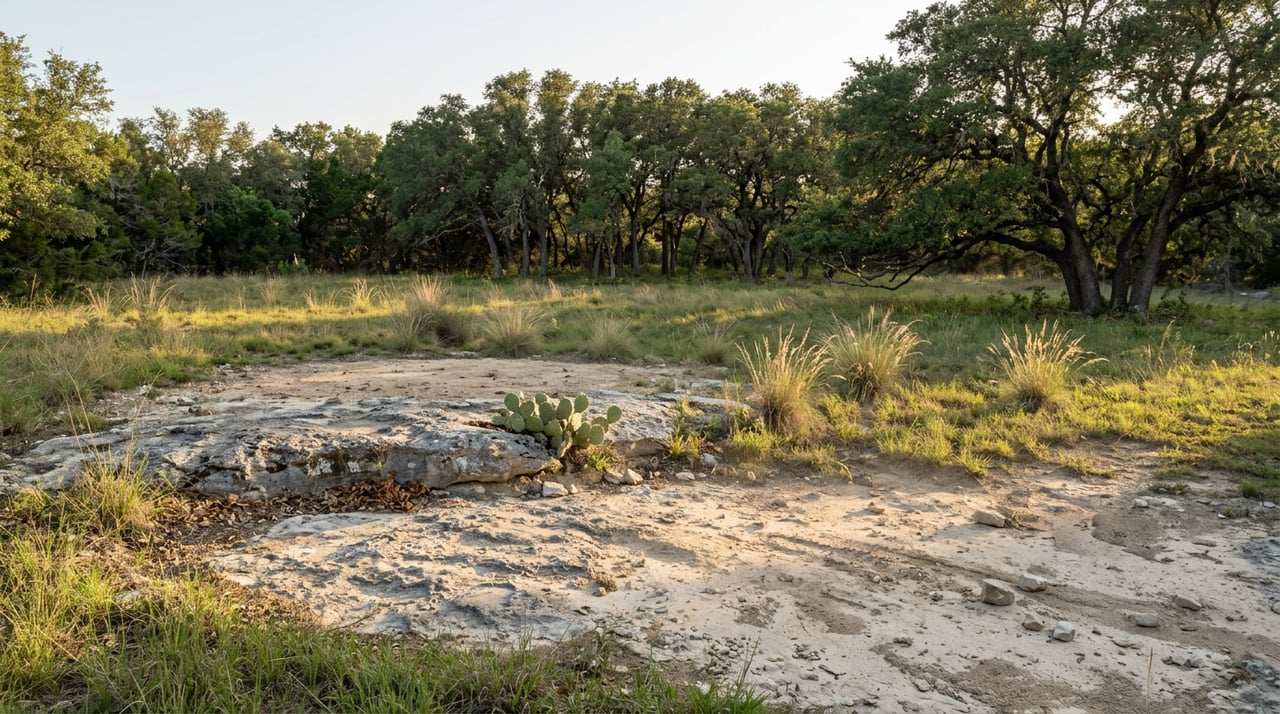
Two lots for sale on the same road outside Spicewood make the point better than any statistic could. Same school zone, same rough acreage, similar tree cover. One was priced at $725,000 and described as build-ready. The other belonged to a subdivision called Travis Club, where lots start at $775,000 before you pay a mandatory club membership on top. Same road. Fifty thousand dollars apart before the club dues even show up on paper.
That gap has nothing to do with the dirt. It has to do with which covenant your lot sits under, and in Spicewood, covenants are only half the story. The other half is which county's septic office you end up dealing with, because Spicewood does something most Hill Country communities don't: it sits directly on top of the meeting point of Travis, Burnet, and Blanco counties. Two lots that look identical in a listing photo can answer to three different permitting offices, three different review timelines, and in some cases three different sets of rules about how close your septic field can sit to your neighbor's well.
If you're buying raw land or a lot in Spicewood, the number that should worry you isn't the price per acre. It's which side of an invisible line you're standing on.
The line doesn't show up on the listing
Spicewood isn't an incorporated city. It has no city hall, no city permit office, and no city building code. What it has instead is a patchwork of unincorporated county jurisdiction, and which county governs your specific parcel changes who reviews your septic design, how long that review takes, and how strict the setback rules are.
Land in the Travis County portion of Spicewood answers to Travis County's development permitting office rather than any municipal building department. There's no city inspector to call, but there is a county process, and it moves on the county's calendar, not yours.
Cross into the Burnet County side, and the office changes, along with the culture of how it handles rural land. Burnet County runs a dedicated development services office and has a reputation for being workable with large rural parcels, but the pace of your project still tends to be set by how long your well and septic take to design and approve rather than by how fast the county stamps the paperwork.
The Blanco County sliver is smaller still, with a permitting operation sized for a smaller county. That means site visits, the kind a licensed evaluator needs to complete before your septic design can even be drafted, sometimes take longer to schedule simply because there are fewer staff to schedule them.
None of this shows up in a listing description. A flyer that says "1.5 acres, Spicewood" tells you nothing about which office will decide whether you can build there, or how long you'll wait to find out.
| County portion | What handles your permit | What tends to set the pace |
|---|---|---|
| Travis County | County development permitting, not a city department | Standard county review queue |
| Burnet County | Dedicated development services office | Well and septic design timeline, more than the permit review itself |
| Blanco County | Smaller county permitting operation | Scheduling the required site evaluation |
Then there's a second line, above the water
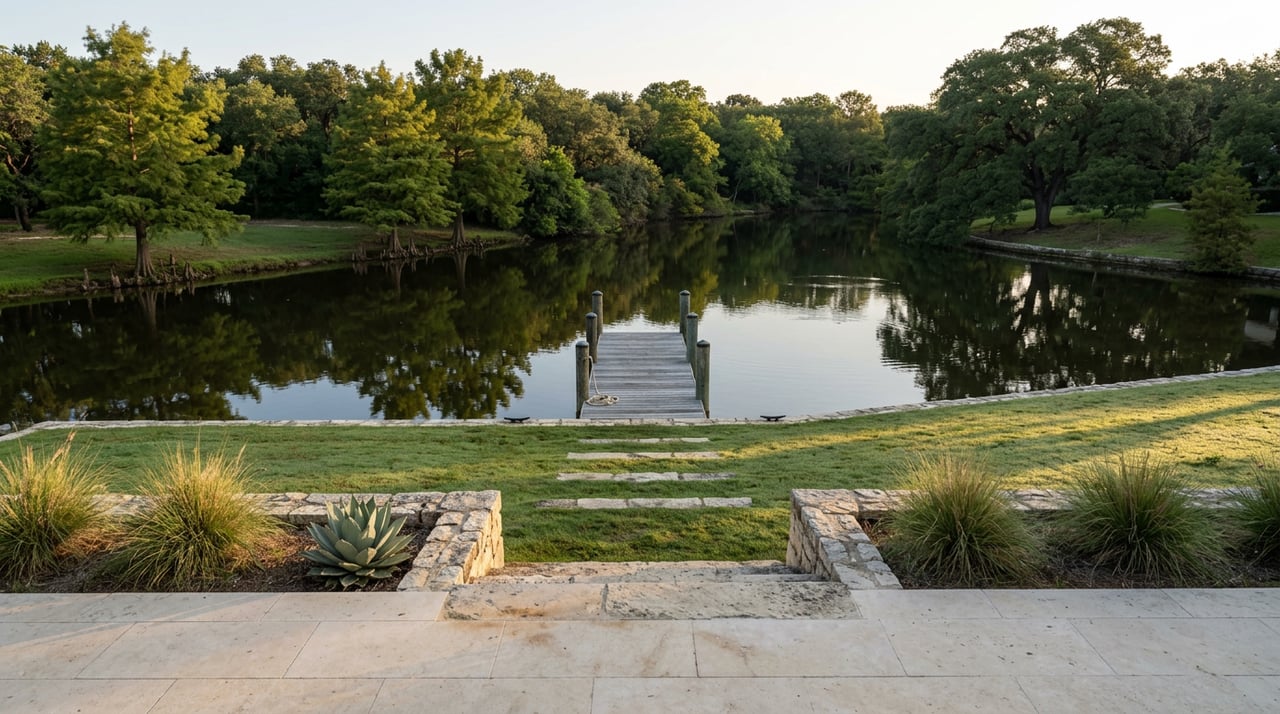
County jurisdiction is the first boundary. The second one belongs to the Lower Colorado River Authority, and it doesn't follow county lines at all. It follows the lake.
The LCRA is direct about this on its own site: owning lakefront property does not automatically entitle you to build a dock or other floating structure. Before anything gets built over the water, an owner has to verify who actually owns the land submerged beneath it, by checking the deed filed at the county tax office, and if someone else owns that submerged land, the owner needs that landowner's permission before a dock can go in at all. Docks that do get built have to meet the LCRA's own safety standards for residential docks on the Highland Lakes.
That review sits entirely outside the county process. A lot can clear Travis County's septic review without ever touching the LCRA's separate approval for anything built within its easement, an approval that recent Spicewood lot listings note is required and secured per lot, not automatically inherited from the subdivision plat.
Lake Travis's full pool sits at 681 feet above mean sea level, and that number matters more than most buyers realize. A lot's elevation relative to full pool determines whether it falls inside the LCRA's flowage easement at all, which in turn determines whether a septic system, a retaining wall, or a dock needs LCRA sign-off in addition to whatever the county already requires. Two lots a few hundred feet apart in elevation can land on opposite sides of that requirement.
What the Travis Club example is really showing you
Go back to the two lots on the same road. The county line explains why one might take longer to permit than the other if they fall in different counties, but it doesn't explain the fifty thousand dollar price gap. That gap comes from something closer to home: mandatory club membership baked into the covenants of one subdivision and absent from the other.
This is the pattern worth internalizing. In Spicewood's patchwork of small subdivisions, gated communities, and unrestricted acreage, the total cost of a lot is rarely just the listing price. Some communities carry no HOA and no mandatory membership at all, with covenants that simply cap what you can build, an accessory dwelling unit at a set percentage of the main home's footprint, for instance, while permitting pools, outbuildings, and horses outright. Others tie a country club or marina membership to the deed itself, adding a recurring cost that never appears in the acreage-and-price headline of a listing.
Before you write an offer on Spicewood land, the covenant document deserves the same scrutiny as the survey. It tells you whether the real cost of ownership matches the listing price or sits well above it.
What the price-per-acre number actually hides
Spicewood land currently averages roughly $872,000 per listing and about $103,700 per acre, based on active inventory. That figure looks enormous next to Burnet County's broader median of $28,596 per acre for land countywide, and it should. Spicewood's premium comes from lake frontage, Hill Country views, and proximity to Austin, not from raw acreage value.
Set it against the wider market and the gap gets sharper still. Statewide, Texas rural land rose 6.02 percent year over year through the first quarter of 2026, reaching $5,246 per acre, according to the Texas Real Estate Research Center at Texas A&M. Even the broader Austin-Waco-Hill Country region, one of the strongest rural land markets in the state through all of 2025, averaged $7,704 per acre. Spicewood trades at more than ten times that regional average.
That premium is precisely why the jurisdictional and easement questions matter more here than almost anywhere else in the Hill Country. When land costs six figures an acre, a septic denial that forces a redesign, a permit delayed by a scheduling backlog, or a club membership you didn't budget for isn't a rounding error. It's a material swing in what the property actually costs you to own.
The scale of ambition drawn to this corridor makes the point on its own. In July 2026, The Real Deal reported that Calvin Chen, founder of Art Hub ATX, listed 517 acres known as the Flying X Ranch for $85,000 per acre, or $44 million altogether, and had already fielded interest from an aviation company eyeing a private airstrip and a car manufacturer exploring a racetrack. Even buyers operating at that scale still answer to the same county lines and the same LCRA easement rules as a family buying two acres for a custom home. The jurisdiction doesn't care how many zeros are in the offer.
A few questions worth asking before you sign
Does the county line actually run through my specific lot, or just through the general area? It can do either. A subdivision can straddle a county boundary internally, meaning your neighbor's septic permit went through a different office than yours will. Ask for the parcel's county appraisal district record, which will confirm the jurisdiction tied to that specific lot rather than the general Spicewood area.
If my septic gets approved by the county, am I done? Not necessarily. If your lot sits within the LCRA's easement above full pool, you may need a separate LCRA approval for the septic system itself, and definitely for any dock, retaining wall, or structure placed over or near the water. County approval and LCRA approval are two different processes run by two different agencies.
Where do I find out if a lot carries mandatory club or HOA fees before I offer? The subdivision's covenants, conditions, and restrictions document will state it directly. If a listing doesn't include that document, request it before you write an offer, not after you're under contract.
Land deals in Spicewood reward the buyer who reads the fine print before the fine print becomes a closing surprise. That's the kind of review Eileen DePew brings to every land and lot transaction in the Hill Country, backed by more than 25 years practicing law before she ever wrote a real estate contract. If you're weighing a parcel in Spicewood and want someone to walk the county lines, the easement boundaries, and the covenant language with you before you sign, get peace of mind when you sign. Schedule a consultation.