Thinking about trading Austin’s city pace for Lake Travis views? It can be an exciting move, but it is not just a change of address. You are often shifting into a higher-priced, more ownership-oriented market with a different daily rhythm, housing mix, and lifestyle focus. This guide will help you compare Austin with Lakeway, Bee Cave, and Spicewood so you can make a more confident move. Let’s dive in.
Austin vs Lake Travis Market
Moving west from Austin usually means entering a smaller market with higher home prices and more variation from one area to the next. In Austin, Redfin’s May 2026 snapshot shows a median sale price of $542,460 and a median of 48 days on market. Census data also shows a 43.4% owner-occupied housing rate, which reflects a market with a larger share of rentals, condos, apartments, and other urban housing types.
By contrast, Lakeway, Bee Cave, and Spicewood each feel more ownership-driven in different ways. Lakeway’s median sale price is $840,040 with 55 days on market, while Bee Cave’s median sale price is $799,522 with 45 days on market. In Spicewood, Zillow’s June 2026 overview shows a median sale price of $717,167, along with 312 for-sale listings and 40 new listings.
The biggest surprise for many buyers is that the corridor does not behave like one single market. Lakeway is the most ownership-heavy, with Census reporting an 86.3% owner-occupied rate and a median owner-occupied home value of $841,300. Bee Cave sits somewhere in the middle, with a more mixed ownership profile and a price point still well above Austin.
Home Styles Change West
If you are used to Austin’s broad housing mix, the move to Lake Travis can feel more focused on detached homes, land, and setting. Austin’s lower owner-occupancy rate and median gross rent of $1,729 point to a wider mix of apartments, condos, townhomes, and older urban housing. That creates more format choices close to job centers, entertainment, and everyday services.
Lakeway Homes
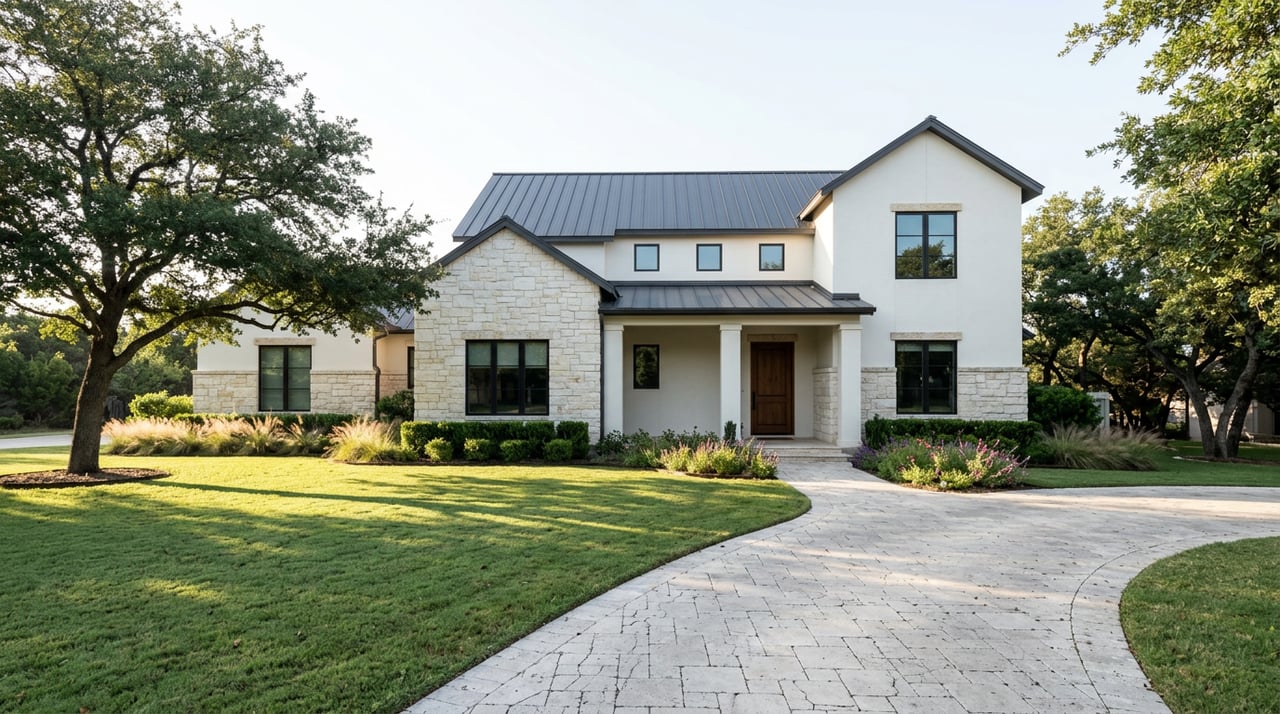
Lakeway’s planning documents describe low-density residential neighborhoods as the primary land-use category, and single-family homes remain the dominant product. The city’s current comprehensive plan does support a mix of housing choices, but the overall identity is still strongly centered on detached homes. If you are moving from central Austin, that often means more house, more lot, and more emphasis on ownership over flexibility.
Lakeway also has a long-standing connection to recreation and lake living. The city says it began as a retirement and second-home community and has grown into a place oriented around golf, tennis, marinas, parks, trails, and greenbelts. That background still shapes how many buyers evaluate homes here.
Bee Cave Homes
Bee Cave often feels like the bridge between Austin convenience and Lake Travis living. Its comprehensive plan supports a broader mix of housing types, including detached and attached single-family homes, patio homes, townhomes, zero-lot-line homes, condos, and multifamily in certain urban-neighborhood areas. That wider mix helps explain why Bee Cave can feel more flexible for buyers who want options beyond a traditional detached suburban layout.
The city also clusters civic, retail, and trail amenities in a way that feels more compact than Lakeway. Bee Cave highlights parks, trails, community events, and a retail-heavy local economy, and its library is located inside Bee Cave City Hall at the Hill Country Galleria. If you want a less urban version of convenience, Bee Cave often stands out.
Spicewood Homes
Spicewood is harder to define by a standard neighborhood checklist. The housing search here often becomes more about land, privacy, lake access, lot features, and the surrounding Hill Country setting than about a typical suburban pattern. For some buyers, that is exactly the appeal.
The area’s recreational assets reinforce that identity. Travis County’s Pace Bend Park offers 1,368 acres, more than nine miles of shoreline, boat ramps, campsites, and hiking, biking, and equestrian trails. LCRA’s Grelle Recreation Area adds another lakefront option nearby, which helps explain why lifestyle conversations in Spicewood often revolve around outdoor time and setting first.
Commuting Feels Different
One of the biggest adjustments is not always the price. It is the daily rhythm of getting around. Even when the map makes the move seem modest, the experience can feel very different once you start driving the corridor regularly.
Lakeway is about 25 miles west of downtown Austin, and Bee Cave is about 14 miles west of Austin. Those distances matter because the area’s main routes serve as both local roads and commuter corridors. In practice, your experience can change a lot depending on where your home sits relative to RM 620, SH 71, or farther west toward Spicewood.
TxDOT says RM 620 runs 23.2 miles from SH 71 in Bee Cave to I-35 in Round Rock and serves as both a local thoroughfare and commuter highway. TxDOT also says SH 71 between Bee Creek Road and Hamilton Pool Road in western Travis County experiences significant congestion and is being improved with medians. That means route choice and timing often matter as much as distance.
Census travel-time data points in the same direction. Mean travel time to work is 23.7 minutes in Austin and 28.8 minutes in Lakeway. While that is only a broad average, it supports what many movers discover quickly: west-of-Austin living often comes with a more car-first, commuter-style pattern.
Lifestyle Shift by Area
The move from Austin to Lake Travis is often less about leaving the city and more about choosing a new routine. If your priorities are space, recreation, views, or a different pace, the tradeoff may feel worthwhile. If you want a highly walkable urban environment with a broad housing menu nearby, the adjustment may feel bigger.
Lakeway Lifestyle
Lakeway is explicitly described by the city as a resort community. It offers golf courses, tennis courts, marinas, a private airport, a full-service hotel and spa, parks, trails, greenbelts, and access to a 65-mile lake. For many buyers, that creates a lifestyle that feels more weekend-oriented, even during the workweek.
Bee Cave Lifestyle
Bee Cave leans more toward a live-work-play setup. The city says residents can bike or hike from Falconhead Boulevard along 620 to Central Park and the Galleria, and the Central Park perimeter trail is just over a mile. That amenity pattern can make day-to-day life feel more connected and compact, even though it is still far less urban than Austin proper.
Spicewood Lifestyle
Spicewood is the most recreation-centered of the three. Buyers often prioritize shoreline access, privacy, outdoor space, and time on the water over being close to a dense retail core. If your ideal day includes boating, trail time, or simply more breathing room, Spicewood may fit that vision better than a traditional suburban setup.
Budget and Search Timing
If you are planning the move, budget and timing deserve close attention. The price jump from Austin can be substantial, especially in Lakeway and Bee Cave. That does not mean every home will be out of reach, but it does mean your must-have list may need to be more targeted.
Market pace also varies by area. Austin’s median days on market is 48, Lakeway’s is 55, and Bee Cave’s is 45. Instead of assuming one Lake Travis timeline, it is smarter to plan your search around the specific micro-market you are targeting.
Recurring costs can vary too. Lakeway notes that municipal utility districts provide water and wastewater service, so it is worth checking those costs parcel by parcel. HOA dues, property upkeep, and maintenance expectations can also differ meaningfully depending on the home type and setting.
How To Decide If The Move Fits
A move from Austin to the Lake Travis corridor usually makes the most sense when your priorities are changing. You may want more space, a detached home, a stronger ownership environment, or easier access to the lake and outdoor recreation. You may also be willing to accept a higher price point and a more driving-oriented routine in exchange.
A simple way to frame your decision is to compare these questions:
- Do you want a broader urban housing mix, or a more ownership-focused market?
- Is daily convenience more important, or is recreation and setting the bigger priority?
- Are you comfortable with a corridor where commute experience can depend heavily on route and timing?
- Do you want a more mixed-use feel like Bee Cave, a resort-style setting like Lakeway, or a land-and-lake focus like Spicewood?
The right answer is not the same for every buyer. What matters is matching the market, home type, and location to the way you actually want to live.
If you are weighing Austin against Lakeway, Bee Cave, or Spicewood, having local guidance can help you compare not just price, but also contract terms, title details, recurring costs, and the day-to-day realities of each micro-market. When you are ready for a clear, careful strategy, connect with Eileen Depew for trusted guidance across the Lake Travis and Hill Country corridor.
FAQs
What is the price difference between Austin and Lakeway in 2026?
- Austin’s median sale price is $542,460, while Lakeway’s median sale price is $840,040 based on the May 2026 market snapshots in the research.
What is the price difference between Austin and Bee Cave in 2026?
- Austin’s median sale price is $542,460, and Bee Cave’s median sale price is $799,522, showing a significant step up for many buyers moving west.
What kind of homes are common in Lakeway compared with Austin?
- Austin has a broader mix of apartments, condos, townhomes, and older urban housing, while Lakeway is more strongly oriented toward low-density neighborhoods and detached single-family homes.
What makes Bee Cave feel different from Lakeway for homebuyers?
- Bee Cave supports a broader mix of housing types and has a more compact mix of parks, trails, civic spaces, and retail amenities centered around the Galleria area.
What should buyers expect from a Spicewood home search?
- In Spicewood, buyers often focus more on land, privacy, lake access, lot characteristics, and outdoor setting than on a typical neighborhood-by-neighborhood suburban comparison.
What is the commute difference between Austin and Lakeway?
- Census data shows a mean travel time to work of 23.7 minutes in Austin and 28.8 minutes in Lakeway, and the corridor’s main routes can feel more commuter-oriented than the map suggests.
What roads matter most when moving from Austin to the Lake Travis corridor?
- RM 620 and SH 71 are major routes in the corridor, and TxDOT notes that both play important roles in traffic flow and daily access.
What lifestyle change comes with moving from Austin to Lake Travis?
- Many buyers trade Austin’s urban convenience and broader housing mix for more space, stronger ownership patterns, lake access, and a more outdoor-centered routine.